
Reviewed · VALENCIA TUK-TUK TOURS
Valencia: Tuk tuk tour
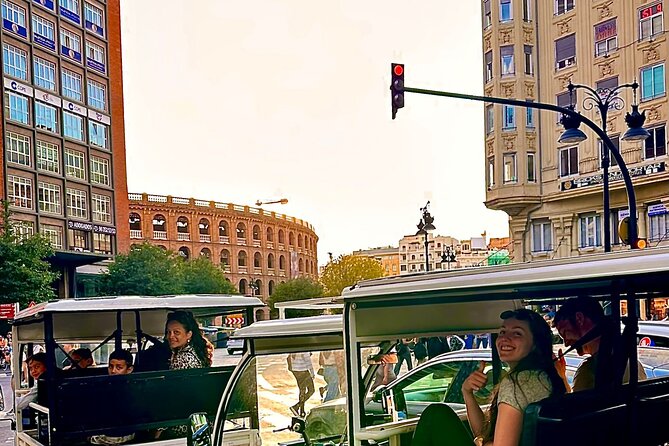
Valencia’s story makes a wide loop: Gothic city gates at one end, the sea and Calatrava’s futuristic Arts and Sciences complex at the other. A tuk tuk covers that span quickly, giving you a useful first look at a city that can feel too spread out to understand on foot in a short visit.
I like two things about this ride: it links very different parts of Valencia in as little as an hour, and the guide can turn passing façades into a readable story. Guides such as Tony, Salvador and Silvio have earned praise for being friendly and good at answering questions. The trade-off is that you’re seeing many sights from street level, through an open vehicle that can be noisy and may not suit every passenger’s view.
Quick points before you book
- A citywide route in a short ride: The tour connects medieval gates, the center, the port, beaches and the City of Arts and Sciences.
- Guides make the difference: Tony, Salvador and Silvio are among the guides named by people who valued the explanations and friendly manner.
- A look, not a full visit: The tuk tuk gives you an overview of the sights, but does not replace time inside places such as the Serrano Towers or Central Market.
- Open-air means exposed: Traffic noise, weather and the vehicle’s roof covering can affect how well you hear or see certain buildings.
- Check the length carefully: The advertised duration is approximately one to two hours. Confirm your booked time, especially if you have plans afterward.
- Small vehicles, group limit: The tour allows up to 12 participants, but a larger party may be split between tuk tuks.
What the tuk tuk route tells you about Valencia

At about $32.44 per person, this is best seen as an orientation ride rather than a transport service or a deep visit to each landmark. You get a broad sense of how Valencia’s old center, former riverbed, seafront and modern cultural district fit together, while a guide supplies the historical links that are easy to miss when you’re moving around on your own.
The listed duration ranges from one to two hours. That is a substantial difference: a one-hour version can only offer a brisk overview, while a two-hour ride has more breathing room for explanations and photos. If the length matters to your plans, confirm the exact duration when booking and again before setting out.
The experience has an average rating of 4.2 out of 5 across 93 ratings. The strongest element is consistently the human one: guides who are warm, informed and willing to answer questions. The most useful cautions are practical. Some rides have faced delays or changes in duration, and mechanical trouble has been reported. The open structure also means street noise can compete with the guide, and some passengers have found the roof covering obstructs views of taller buildings.
More tuk-tuk tours around Valencia:
- Valencia: Complete Tuk-Tuk Tour Around the City
★ 4.8 · 793 reviews - Valencia Complete Tour by Tuk Tuk
★ 4.5 · 593 reviews - Valencia: 2-hour City Highlights Guided Tuk-Tuk Tour
★ 4.7 · 233 reviews
From Serrano Towers to the old city gates
The route starts with one of Valencia’s clearest links to its medieval past: the Serrano Towers. Built between 1392 and 1398 by Pere Balaguer, they formed part of the city walls and served as a defensive entrance for people arriving from the Serranos area. Their two polygonal towers flank a central arch, a solid, purposeful design that still reads as a fortified gateway.
The towers later served as a prison for nobles and now function as a historic monument. You can enter and climb for a view over the city, but a tuk tuk stop should not be mistaken for an interior visit. If the climb interests you, plan a separate visit rather than counting on the tour to include it.
The Sea Gate is a reminder that not every old-looking monument is medieval. Rebuilt in 1946 to honor those killed in the Spanish Civil War, it has three white-stone arches, with the center one largest. That contrast between historic city walls and a modern memorial helps explain how Valencia’s public spaces carry several periods of history at once.
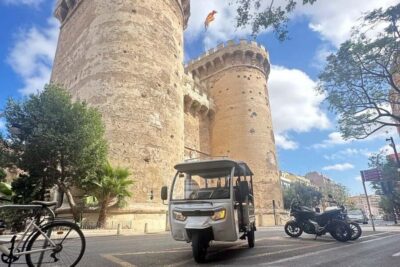
The Quart Towers, another pair of medieval gates, were built between 1441 and 1460 on the road connecting Valencia with the west and north. Their cylindrical towers and brickwork give them a tougher look than the Serrano Towers. They were damaged during the War of Independence and restored in the 19th century. Seeing both gateways makes the old defensive ring easier to picture, even if you only glimpse them from the road.
Across the Turia Gardens and past Mestalla
The Turia Gardens occupy the former course of the Turia River. The route passes a flower-covered bridge opened in 2002, built to provide another crossing over the gardens. Its floral display changes every four months, so its appearance depends on the timing of your visit. The changing flowers are also the reason the bridge has gained a reputation as an expensive one to maintain.
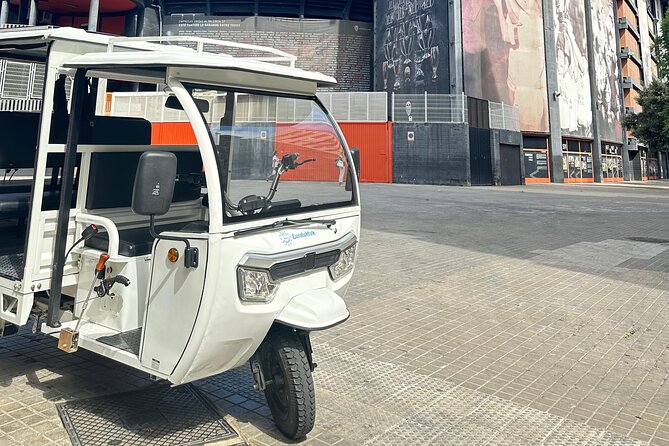
Nearby, Mestalla offers a different kind of civic passion. Opened in 1923, it is home to Valencia CF and is known for steep stands that bring the crowd close to the pitch. The stadium holds about 50,000 people. From a tuk tuk, you get the exterior and a sense of its scale, not a tour of the ground or a match-day experience.
This part of the route shows why the ride is useful early in a stay. In a short span, you move from a former river channel turned public garden to one of the city’s major sporting landmarks. It is a quick lesson in how Valencia has reused space and built new identities around it.
The port, beaches and the city’s edge
Valencia’s old port covers about one million square meters and mixes maritime activity with culture, business, sport and food. Veles e Vents, with its striking modern design, hosts exhibitions, dance and other arts events. The old shipyard and Tinglados add older port architecture to the scene, while more than 800 private moorings serve boats, clubs and water-sport groups.
The scale is hard to take in from a moving vehicle, but the ride helps you understand that the port is not simply a place to board a boat. It is a large working and leisure district. If you want to spend time in a restaurant, see an exhibition or take part in a water activity, you’ll need to return on your own.
The route also reaches Valencia’s best-known beach and Las Arenas, named for the old fishing quarter and an earlier seaside spa. The broad, fine golden sand and easy access from town help explain why locals use the beach as part of everyday city life. The former spa is now a luxury hotel complex, and the seafront includes restaurants and entertainment. Some venues, including Marina Beach Club, shift into nightlife.
The beach portion is one of the ride’s strongest changes of scene. It gives you sea air and a glimpse of Valencia beyond its monuments, without requiring you to make the trip separately. But a drive past the shore is not beach time. Bring your own plan if you want to swim, eat by the water or linger in the sand.
More trips and days out around Valencia:
- Valencia: Oceanogràfic Entry Ticket
★ 4.7 · 9,893 reviews - Valencia: 24 or 48-Hour Hop-on Hop-off Bus Ticket
★ 3.9 · 5,611 reviews - Valencia: Palosanto Flamenco Show Ticket
★ 4.8 · 3,876 reviews - Valencia: Catamaran Cruise with Sunset Option
★ 4.0 · 3,566 reviews
Calatrava’s City of Arts and Sciences

The City of Arts and Sciences is the route’s boldest visual contrast with the medieval center. Designed by Santiago Calatrava and Félix Candela, this large cultural and leisure complex began construction in 1996 and was completed in 2009. Its scale and futuristic forms make it one of Valencia’s defining modern sights.
A tuk tuk is a handy way to get a first impression of the complex and its setting. You can see why it became a major symbol of the city’s efforts to build an international cultural and scientific center. But the complex contains more than one attraction, and the ride is not a substitute for entering any of them. If you want to spend time inside, reserve time beyond the tour.
For many visitors, this is the point where the city’s range clicks into place. You’ve seen fortified gates, a modernist center, a port and a beach, then arrive at a monumental project built in the late 20th and early 21st centuries. The route’s value lies less in lingering at one stop than in making those contrasts legible.
Modernist markets, the station and the bullring
Back toward the center, the tour passes Mercado de Colón, a modernist building opened in 1928. Architect Francisco Mora’s design uses colorful mosaics, ornate columns and a large glass dome. Renovated in 2003, it now houses restaurants, cafés and gourmet food businesses. It is a good place to return to if you want a meal or a closer look at the architecture.
Do not confuse Mercado de Colón with the Central Market, also opened in 1928. The Central Market was designed by Francisco Guardia and Alejandro Soler as a modern place for fresh produce. Its iron-and-glass dome, ceramics and decorative details make it a landmark in its own right, while its working stalls give it a practical purpose beyond sightseeing. It sits close to La Lonja and Plaza del Ayuntamiento, so it is easy to pair with a self-guided walk through the center.
The North Station, opened in 1917, is another reason to look beyond the road ahead. Demetrio Ribes designed the station with colorful ceramics, Valencian-style tiles and ornamental details. Its elegant interior has a storybook quality, but you will need to enter separately to appreciate the lobby and waiting area properly.
The neoclassical Bullring opened in 1859. Designed by Sebastián Monleón, it has a circular brick exterior, Doric columns and a form inspired by the Roman Colosseum. It holds about 10,000 people and now hosts cultural events and concerts as well as bullfighting. The tuk tuk offers a quick look at the building’s scale and design; it does not explain the contested place of bullfighting in Spanish culture in any depth.
Together, these central sights show how Valencia’s commercial and transport history shaped its appearance. The markets were built for trade, the station for rail travel, and the bullring for public spectacle. A guide’s short explanations help connect those uses, though you may want to revisit the places that catch your interest.
How to get the most from the ride
I’d book this near the start of a Valencia stay, when a broad overview can help you decide where to spend more time. It is especially useful if you have only a few days, are traveling in hot weather, or want to cover ground without walking the full distance between the center, beach and modern district. One person described the ride as a way to get a feel for the city in about 90 minutes, and that is the right expectation.
The tour includes one bottle of water per person. It is a thoughtful inclusion, particularly in summer, but it is not a substitute for dressing for the weather. One passenger specifically advised dressing warmly, while another recommended avoiding the hottest part of an August afternoon. In warm months, a morning or late-evening time may be more comfortable if available.
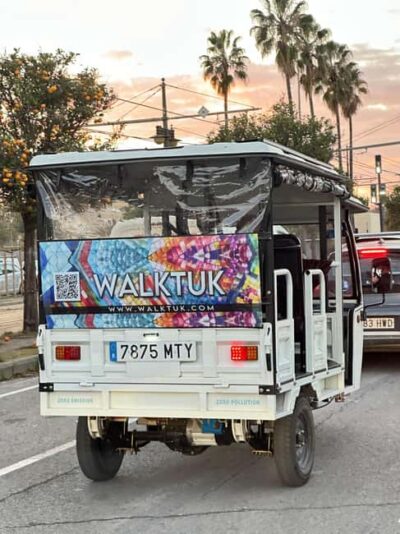
The vehicle is open-air, but it has a covering. That setup can be fun and gives you a close-to-the-street view, yet it brings two limitations: traffic noise can make commentary harder to hear, and the covering may block upward views for some passengers. If clear sightlines to tall façades matter to you, a walking tour may suit you better.
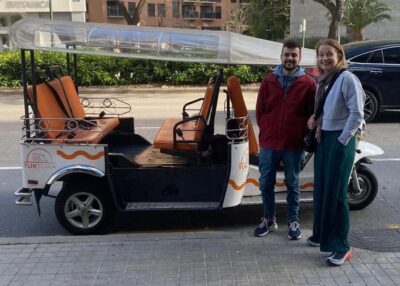
The listed maximum is 12 participants. Individual tuk tuks have limited seating, and a party of five may be divided between two vehicles. Ask about seating arrangements before booking if staying in one group is important. The tour is offered in English, Spanish, Portuguese, Italian and German, and the guide’s language should be clear when you choose a time.
The meeting point is C. de la Blanqueria, 3, Ciutat Vella, and the tour ends back there. It is near public transportation, but make sure you have the address ready rather than relying on a driver to find the operator for you. The activity is listed as suitable for most participants, and service animals are allowed.
The price includes the ride, guide and bottled water, but not a tip. Free cancellation is available up to 24 hours before the start time; cancellations inside that window are not refundable. The tour is booked, on average, 26 days ahead, so reserve early if you have a fixed schedule, while still checking the exact duration and meeting details.
Should you book the Valencia tuk tuk tour?
Book it if you want a fast, friendly orientation that links Valencia’s old center with the port, beaches and City of Arts and Sciences. It offers good value when the alternative is trying to cover the same ground on foot in a short stay, and the guide can add the local context that a self-guided drive lacks.
Skip it if you want long stops, quiet commentary or a close look inside monuments. It is also worth considering another format if you are especially sensitive to vehicle noise or need an unobstructed view of upper façades. Before paying, confirm whether your booking is for one or two hours, ask how a larger party will be seated, and leave room in your schedule for possible delays. For an overview rather than an in-depth visit, this is a practical way to get your bearings.
FAQ
How long is the Valencia tuk tuk tour?
The approximate duration is one to two hours. Confirm the length of the specific tour you book, as the difference affects how much of the route you can cover.
What is the price?
The listed price is $32.44 per person. Group discounts are available, but the discount amount is not specified.
What languages are offered?
Guides are available in English, Spanish, Portuguese, Italian and German.
Is bottled water included?
Yes. One bottle of water per person is included.
Where does the tour start?
The meeting point is C. de la Blanqueria, 3, Ciutat Vella, 46003 València, Valencia, Spain.
Where does the tour end?
The activity ends back at the meeting point.
How many people can join?
The activity has a maximum of 12 participants. Larger parties may need to use more than one tuk tuk.
Which sights are included on the route?
The route includes sights such as the Serrano Towers, Quart Towers, the Sea Gate, Mestalla, the port, Valencia’s beaches, the City of Arts and Sciences, Mercado de Colón, the bullring, North Station and Central Market.
Can I cancel for a refund?
You can cancel at least 24 hours before the start time for a full refund. Cancellations made less than 24 hours before the tour are not refundable.
Just added around Valencia
- Chill and Sail in Valencia★ 5.0 · 24 reviews
- Requena Somm. Private Vineyards/ Premium Wine tasting 1/2 Day★ 5.0 · 5 reviews
- Full Day Private Requena Wineries Premium Tastings★ 5.0 · 3 reviews
- Private Tour of Valencia City★ 5.0 · 5 reviews
- Private tour of the old city of Valencia★ 5.0 · 9 reviews
- Valencian Paella class with welcome drinks and tapas★ 4.0 · 24 reviews
- Private Walking Tour of Games and History in the Center of Valencia★ 5.0 · 9 reviews
- Valencia: City of Arts and Sciences Private Walking Tour★ 5.0 · 10 reviews
Valencia Tuk-Tuk Tours, compared.


Valencia by Tuk Tuk i: Private tour 1 or 2 hours explore the city
Read our review →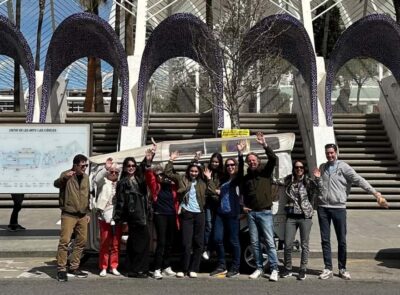
Browse the lists this tour appears in